
Reading the Record
Great Liner Notes in Jazz

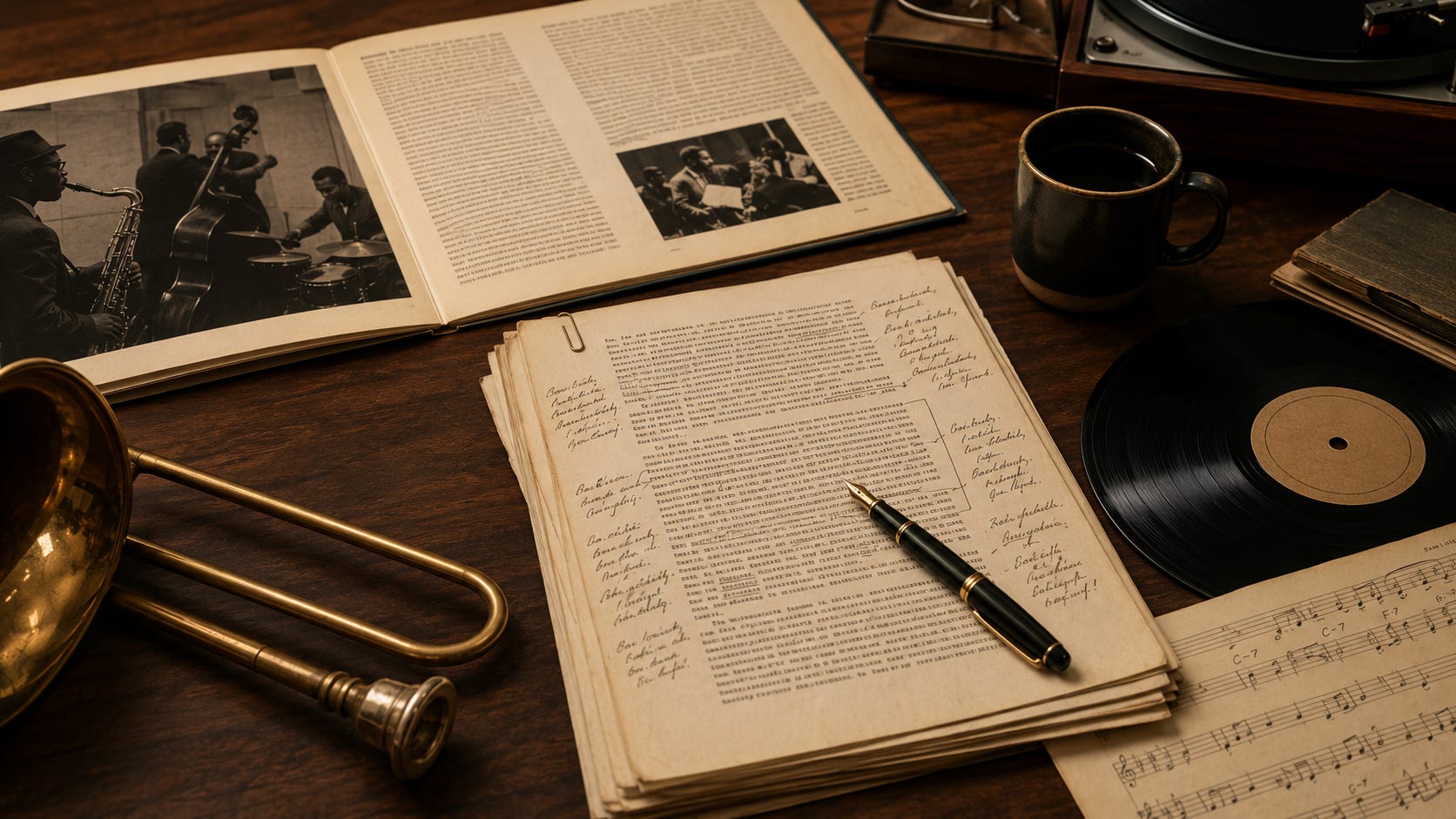
I might be totally dating myself here, but I still believe the best way to listen to an album is with the physical liner notes firmly in hand. The useful ones identify an arranger whose contribution might otherwise go unnoticed, explain a change in instrumental color, preserve a musician’s account of how a composition developed, or document the circumstances of a session. They give me something specific to listen for. Other notes offer a personnel list and several paragraphs of praise.
I am thinking about that difference because I am writing liner notes for a forthcoming jazz-orchestra album by a longtime friend, colleague, and collaborator. I also played bass trombone on the recording. I am using this essay to work through what makes liner notes viable as criticism, compelling as writing, and useful to the listener. I also want to understand where my own position fits within a tradition shaped by critics, historians, producers, musicians, and writers who knew the music closely.
Jazz liner notes have historically established personnel and authorship, recorded what happened in the studio, explained how compositions and arrangements work, and preserved musicians’ accounts of their own development. They have also documented the budgets, contracts, travel, segregation, family responsibilities, and institutional support that shaped a recording. The strongest examples connect those conditions to the music and give the listener information that the record cannot supply by itself. The writers considered here show how liner notes can operate as musical interpretation, oral history, cultural history, documentation, and an invitation to listen more closely, moving roughly from the sound itself outward to the conditions that made it possible.
Bill Evans and the Governing Idea
Bill Evans’s original essay for Miles Davis’s Kind of Blue, “Improvisation in Jazz,” demonstrates how one clear idea can organize an entire album. Evans begins with Japanese ink painting, where each brushstroke must be placed with commitment because “erasures or changes are impossible.” He applies the image to improvisation: each note, silence, and response remains in the performance, and in a group, every musician must follow the developing form while responding to the others.
Evans briefly identifies the frameworks Davis provided. “So What” uses a modal structure. “All Blues” is a blues in 6/8. “Flamenco Sketches” gives each soloist a sequence of scales and allows the player to decide how long to remain within each one. Evans’s larger concern is the discipline created by those frameworks.
The ink-painting analogy directs attention to the musicians’ commitment to each gesture and their shared responsibility for the developing form. The listener can apply that idea to Paul Chambers’s opening figure in “So What,” the space around Davis’s phrases, the transition between scales in “Flamenco Sketches,” and the rhythm section’s response to each soloist. Evans does not provide a technical analysis of every piece. He gives the listener a concept that applies across the record, and one well-chosen image establishes what to follow.

Nat Hentoff and the Musician’s Own Analysis
Nat Hentoff’s notes for John Coltrane’s Giant Steps place Coltrane’s analysis at the center of the essay. Coltrane discusses his practice routine, his work at the piano, his changing approach to harmony, and his concern that prolonged technical study could make his playing sound like an exercise. He explains the bass movement behind “Giant Steps,” the relationship between “Countdown” and “Tune Up,” and the personal associations behind “Cousin Mary,” “Syeeda’s Song Flute,” and “Naima.”
These comments document compositional decisions that a critic could otherwise only infer. They also show how Coltrane understood the relationship among practice, composition, and improvisation, with harmonic development appearing as sustained labor involving repetition, revision, and uncertainty. Hentoff treats Coltrane as an analyst of his own music, someone who defines the problems he is trying to solve and explains the methods he has developed to address them. A musician’s statement earns its place in liner notes on those terms: when it explains a method, corrects an assumption, or identifies a concern that the finished recording cannot establish on its own.
Orrin Keepnews and the Work of the Session
Orrin Keepnews wrote the notes for Thelonious Monk’s Brilliant Corners as producer and witness. He describes the repeated takes, Monk’s revisions, and the concentration required by the title composition, staying close enough to the sessions that the account reads as testimony rather than reconstruction.
Keepnews also records details that explain the album’s textures. Monk plays celeste with one hand and piano with the other on “Pannonica.” Max Roach moves between drums and timpani on “Bemsha Swing.” During the sessions, Monk continued adjusting phrasing and other details, and the title piece placed unusual demands on the musicians through its form, meter, phrasing, and tempo.
Keepnews shows Monk testing the composition and requiring the band to meet its structural demands. The session history helps explain the tension and precision audible in the finished performance. Accounts of difficult sessions often acquire unnecessary drama through repetition, and conflict, fatigue, and multiple takes become proof of genius rather than evidence of craft. Keepnews avoids that drift by staying close to what the musicians actually had to solve.
André Hodeir, Pete Welding, and Orchestral Detail
André Hodeir’s notes for Miles Davis and Gil Evans’s Miles Ahead show how a writer can discuss orchestration while keeping technical detail tied to audible effects. He explains how Davis’s flugelhorn functions against the orchestra, and he directs attention to Evans’s use of tuba, the placement of accents, the movement of ensemble backgrounds, and the continuity among the album’s pieces. He identifies specific passages, including the tuba writing in “My Ship” and the brass figures in “Springsville.”
Pete Welding addresses related questions in his reissue notes for Birth of the Cool. He explains how trumpet, trombone, French horn, tuba, reeds, and rhythm section produce an orchestral range of color with nine players, and he describes how the arrangements frame the improvised solos and guide the ensemble back into the written material. Both writers connect technical language to the recording. Terms such as register, voicing, counterpoint, and inner motion are useful when they identify a passage or effect.
Saying that the tuba sits inside a voicing is incomplete. The writer should explain whether it darkens the harmony, reinforces an inner line, adds weight beneath the soloist, or changes the ensemble balance. The same standard applies to bass trombone, French horn, bass clarinet, baritone saxophone, and the lower reeds generally. A list of instruments identifies the ensemble, while musical description explains what those instruments do in the arrangement, and from here, the strongest liner-note writing tends to widen its lens further still, from what an instrument does to what made its presence possible in the first place.
Evans, Hentoff, Keepnews, Hodeir, and Welding show how liner notes can interpret improvisation, preserve musicians’ accounts, document a session, and explain orchestral writing. Robin D. G. Kelley widens the form further by connecting recordings to labor, institutions, families, communities, and archival history.
